
THE 3% PRINCIPLE
Why the Decisions You Don't Validate Are the Most Expensive Ones You'll Ever Make
A practical guide to decision validation — what it costs, what it saves, and why most businesses do it completely backwards.
There is a moment in every significant business decision where someone, maybe you, feels enough confidence to say: “Let’s just move forward.”
The analysis feels solid. The logic checks out. The team is aligned. The budget is approved.
And then, six months later, the project is 40% over budget, key people are frustrated, the scope has ballooned into something unrecognizable, and the expected result has been quietly moved to “next quarter” for the third time.
Sound familiar?
Here is the brutal truth: the problem usually wasn’t the execution. It was the decision that launched the execution. Specifically, it was a decision that was never properly validated before it was acted upon.
This article is about a simple, powerful concept, one that most organizations ignore until it’s too late: Decision Validation. The idea that spending a small amount, typically 2–4% of a decision’s projected impact, to stress-test that decision before you commit, is the single highest-leverage investment a business can make.
And more importantly, the research is overwhelming: the cost of not doing it is staggering
Let's Start With a Simple Scenario
Imagine you’re the owner of a $5 million manufacturing company. You’ve decided to implement a new ERP system, enterprise resource planning software that will connect your operations, inventory, finance, and fulfillment into a single platform. Your vendor has quoted you $400,000 for the project, and your leadership team agrees it’s the right move.
Before you sign, someone on your team suggests spending $12,000 to do a structured validation study: interviewing the actual end users, mapping your current workflows, identifying the real pain points, and independently verifying that this ERP is the right fit for those pain points.
You think: “We already know this is the right decision. That $12,000 is a waste.” You sign the contract and move forward.
Eighteen months later, the system is live — but barely used. Your team has developed workarounds. The promised efficiency gains never materialized. You’ve spent $680,000 instead of $400,000. And you’re now being quoted another $90,000 to ‘fix’ the implementation. |
This is not a hypothetical. Variants of this story play out thousands of times a year in businesses of every size. And in almost every case, the validation step — the $12,000 investment — would have surfaced the misalignment before the commitment was made.
That $12,000 was 3% of the original project cost. The failure ultimately cost 70% more than budgeted, plus ongoing remediation expenses. That’s the math that organizations consistently get backwards.
What Decision Validation Actually Is
Decision validation is the deliberate act of stress-testing a significant decision — before acting on it — to confirm that:
- The problem you’re solving is the actual problem (not a symptom)
- The solution you’ve chosen fits the real constraints of your organization
- The assumptions embedded in your decision hold up under scrutiny
- The people who will be affected are aligned in ways that matter
- The expected outcome is measurable, realistic, and achievable
It is not the same as analysis paralysis. It is not a committee review. It is not slowing down for the sake of caution.
Decision validation is a structured, time-boxed process — usually 1 to 4 weeks — that gives a significant decision a fighting chance of succeeding once it’s deployed. Think of it as the diagnostic you do before surgery. You don’t skip the MRI because you’re confident about the procedure.
The goal is not to second-guess every decision. It is to protect decisions that are worth protecting — the ones with real money, real people, and real consequences on the line.
Validation typically costs between 2% and 4% of the projected impact of the decision. For a $500,000 initiative, that’s $10,000 to $20,000. For a $2 million program, that’s $40,000 to $80,000. Relative to the consequences of getting it wrong, these are not large numbers.
What the Research Actually Says About Decisions Gone Wrong
If you’re skeptical that this is a real problem, the data will change your mind. The numbers below are not cherry-picked edge cases. They are the averages — the normal cost of doing business when decisions aren’t properly validated.
70%
of all organizational projects fail to deliver what was promised
Harvard Business Review / McKinsey
$122M
wasted for every $1 billion spent on projects — 12.2% of total investment
PMI Pulse of the Profession
66%
of enterprise software projects experience significant cost overruns
McKinsey / Oxford University
Pause on that middle number for a moment. The Project Management Institute analyzed 2,500 project managers and senior executives. Their finding: for every $1 billion spent on projects in the U.S., $122 million was wasted due to poor management, misaligned decisions, and preventable failures. That’s not the cost of bad luck. That’s the cost of validated decisions that weren’t validated.
Now consider the breakdown of why projects fail, because this is where the connection to decision quality becomes undeniable.
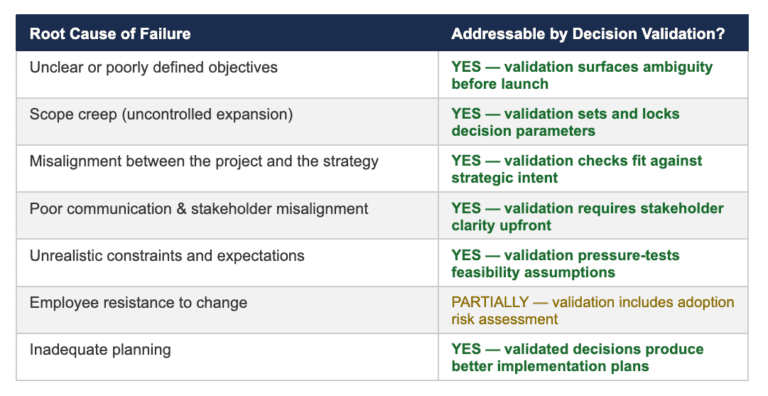
The Real Price Tag: What "Moving Forward" Without Validation Actually Costs
Organizations don’t just pay once for a bad decision. They pay in installments — and the payment schedule is brutal. Here are the six ways the cost shows up:
1. Rework Costs — The Most Predictable Expense You're Not Planning For
When a major IT project is built on a poorly validated decision, something specific and expensive happens: the work gets done, then has to be redone. According to research by McKinsey and the University of Oxford examining over 5,400 IT projects, the average large-scale software project ran 45% over budget and delivered 56% less value than projected. Separate McKinsey research found that large-scale infrastructure projects regularly exceed budgets by 80%.
Those overruns aren’t caused by bad luck. They’re caused by building on top of a decision that was never truly tested. The rework — the meetings to realign, the change orders, the redesigns, the additional developer time — is the direct cost of skipping the validation step.
2. Scope Creep — Death by a Thousand "Small" Changes
Scope creep is what happens when a decision is made before anyone fully understands the problem. It starts small: one extra feature, one additional stakeholder need, one ‘while we’re at it…‘ request. Then it compounds.
The Project Management Institute has consistently found that scope creep is among the top causes of project failure. The cost isn’t just the direct addition of work — it’s the team morale erosion, the timeline pressure, the quality compromises, and the client relationship damage that follows. A home renovation scoped for 8 weeks and a fixed budget routinely extends to 16 weeks and 60% over budget once scope begins to drift. The pattern is universal.
Decision validation addresses this directly by forcing clarity on what the decision includes — and, critically, what it explicitly does not include — before any resources are committed.
3. Change Management Failure — The Invisible Multiplier
McKinsey’s research across thousands of organizations found that roughly 70% of change programs fail to meet their intended goals, with employee resistance and lack of management support cited as the leading reasons. Even among organizations that consider themselves good at change, only 34% of major initiatives are judged fully successful.
What’s going wrong? The decisions to change are made without adequately validating the readiness of the organization to absorb them. Leaders assume alignment that doesn’t exist. They skip the step of confirming that the people who must adopt the change actually understand it, believe in it, and have what they need to execute it.
The cost is paid downstream in the form of passive resistance, disengagement, workarounds, and ultimately adoption failure — where a technically successful project produces zero business results because nobody is actually using it the way it was intended.
4. Adoption Failure — The Outcome No One Talks About
Consider this: 60% of companies don’t measure ROI on their projects. That number, documented across multiple project management studies, is not a management oversight. It’s a symptom of a culture that is more comfortable with completing projects than with confirming whether those projects actually produced the results they were built to produce.
Adoption failure happens when a project is technically delivered but behaviorally ignored. The new system goes live. The new process is documented. The new structure is announced. And then — nothing changes. People revert to the old way. The investment produces no return.
This outcome is almost entirely predictable — and preventable — with adequate decision validation that includes stakeholder readiness and adoption planning as part of the validation criteria, not as an afterthought.
5. Over-Scoped and Under-Scoped Decisions — The Goldilocks Problem
Not all bad decisions are too ambitious. Some are too small. An organization decides to solve a problem with a partial fix — one that addresses the symptom but not the cause — and then wonders why the problem keeps coming back. Months later, they’re back at the table making another investment in the same problem. This is the cost of under-scoped decisions.
Over-scoped decisions have the opposite problem: they try to solve everything at once, create complexity that collapses under its own weight, and produce outcomes that satisfy no one. Both failure modes share a common origin: a decision made without sufficient validation of scope, fit, and feasibility.
6. Opportunity Cost — The Losses That Don't Show Up on the P&L
Every dollar committed to a poorly-validated decision is a dollar not available for a well-validated one. Every month a failed project occupies leadership attention is a month not spent on higher-leverage activity. Every skilled team member exhausted by rework and change management chaos is a team member not innovating, selling, or building.
The PMI found that organizations with mature project management practices — the ones that validate before they execute — waste 28 times less money than their less disciplined counterparts. That gap is almost entirely attributable to decision quality.
The Math You Can't Ignore
Here is what the comparison looks like in real numbers. The following scenarios are representative of real organizational decision types, using cost-of-failure estimates drawn from documented averages across McKinsey, PMI, Gartner, and Harvard Business Review research:
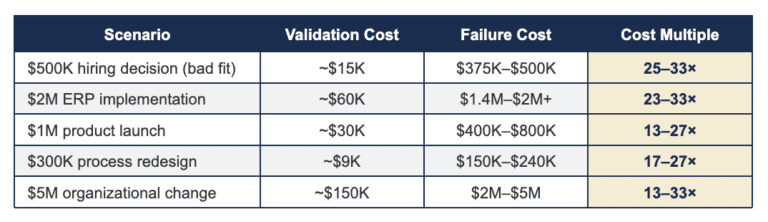
The pattern is consistent: the cost of failure is typically 15 to 30 times the cost of proper validation. No investment with that kind of return profile gets ignored in a well-run business — unless the decision-maker doesn’t recognize they’re making a choice.
The question is never whether to spend money on a significant decision. The question is whether you spend it before — when you still have options — or after, when you don’t.
So Why Don't Most Organizations Validate Their Decisions?
If decision validation is this powerful, this straightforward, and this clearly supported by data — why do most organizations skip it? The answer is a combination of psychology, culture, and organizational incentives:
Confidence gets confused with correctness. Decision-makers who are experienced, knowledgeable, and smart are especially susceptible to this. They’ve made good calls before. They trust their judgment. They don’t feel like they need to validate what they already know. The problem is that organizational complexity doesn’t care about individual confidence.
Validation looks like delay. In organizations that reward speed and action, the suggestion of a validation step can be misread as hesitation, second-guessing, or a lack of commitment. The pressure to move — to show progress, to execute — drowns out the value of a brief pause to confirm direction.
The cost of failure is hidden. When a project fails, the costs are distributed across budget lines, team morale, opportunity cost, and management time. Nobody writes a report titled “Cost of Not Validating the Q3 Initiative.” Because the costs are invisible and diffuse, the investment in preventing them never gets prioritized.
There is no standard process. Most organizations don’t have a defined decision validation framework. They may do some version of it informally — business cases, stakeholder reviews, feasibility studies — but without a structured approach, the validation is incomplete, inconsistent, and often treated as a checkbox rather than a genuine quality gate.
Success gets misattributed. When a decision succeeds despite being unvalidated, the success is attributed to the decision itself and the team that executed it. The luck element — the fact that the assumptions happened to hold — goes unacknowledged. This reinforces the belief that validation wasn’t necessary, setting the stage for the next failure.
What Good Decision Validation Actually Looks Like
Effective decision validation is not a months-long committee review. It is a structured, time-bounded process — typically 1 to 4 weeks — that moves through five critical disciplines:
Problem Validation: Is the problem you’re solving the real problem? This sounds obvious until you examine how frequently organizations invest heavily in addressing the wrong root cause. A thorough problem validation interviews multiple stakeholders, maps existing workflows, and confirms that the proposed decision addresses the actual source of pain.
Solution Fit Assessment: Is the chosen approach genuinely the best fit for your specific organization, constraints, and context? Decision validation doesn’t assume that the first or most popular solution is the right one. It actively tests alternatives and confirms selection logic.
Assumption Testing: Every significant decision rests on a set of assumptions — about timelines, about team capacity, about market conditions, about stakeholder behavior. Decision validation makes those assumptions explicit and then stress-tests them systematically. The ones that don’t hold are surfaced before they become expensive surprises.
Stakeholder Alignment Audit: Are the people who need to support, adopt, and sustain this decision actually aligned — not just verbally, but behaviorally? Validation asks the harder questions: Who has reservations? Where is the resistance? What does successful adoption actually require? These answers reshape both the decision and its implementation plan.
Decision Architecture: The final validation output is not just a “go/no-go” determination. It is a decision architecture — a clear structure that defines who is accountable for what, how future decisions within the initiative will be made, what thresholds trigger re-evaluation, and what success looks like in measurable terms.
Organizations that build decision validation into their operating cadence don’t just reduce failure rates. They develop a compounding institutional advantage — the ability to commit confidently, execute cleanly, and course-correct early.
The Business Case in Plain Language
Let’s be direct about what this means for a business owner or senior leader:
Every significant decision you make without validation is a bet. Not a calculated bet with known odds — a blind bet, made with confidence you may not have earned yet. Most of the time, the bet wins. And when it doesn’t, the losses are large enough to cost you a year of momentum, a significant percentage of capital, and the trust of the people who had to absorb the consequences.
Decision validation converts that blind bet into a calculated one. It doesn’t guarantee success. But it dramatically increases the probability of it, and it dramatically reduces the severity of failure when things don’t go as planned — because the plan was built on tested assumptions, not assumed ones.
The businesses that are consistently out-executing their peers are not doing so because they have better ideas. They are doing so because they are making better decisions — and their decisions are better because they are validated before they’re deployed.
The 3% Principle
Spend 2–4% of a decision’s impact to validate it before you commit.
Or spend 30–80% of it to fix what the decision broke.
The math always favors validation. The question is whether you’ll do it before the decision — or after.
Sources & Research References
- Project Management Institute (PMI). Pulse of the Profession 2016. Findings based on interviews with 2,500 project managers and executives; $122M wasted per $1B invested.
- McKinsey & Company / University of Oxford. “Delivering Large-Scale IT Projects on Time, on Budget, and on Value.” Study of 5,400+ IT projects; average cost overrun of 45%, value delivery 56% below target.
- McKinsey & Company. “The Inconvenient Truth About Change Management” (2009). Survey of 1,546 executives; 70% of change programs reported incomplete or unsuccessful outcomes.
- PwC. Project Management Global Survey (Third Edition). 2.5% of companies completed 100% of projects successfully; poor estimation identified as leading contributor to failure.
- Gartner Research. IT project failure rate 50% higher for budgets over $1M vs. under $350K.
- Harvard Business Review. Average IT project budget overrun: 27%; 1-in-6 IT projects experiences 200%+ cost overrun and 70%+ schedule overrun.
- Standish Group Chaos Report. 39% of all projects succeed fully; 43% challenged; 18% fail outright.
- Boston Consulting Group / McKinsey. 70% of digital transformation projects fail to meet objectives.
- CEB Corporate Leadership Council (2016). Average organization has undergone five major changes; only 34% of those initiatives were judged successful.
- PMI (2017). Organizations using proven PM practices waste 28× less money than those without structured processes.
Author Note
Some portions of this article may include AI-generated text or insights derived through AI-assisted research. Information was gathered from a variety of reputable sources, including news outlets, media organizations, and publicly available reports.
The views and interpretations expressed here are solely those of Christopher Donaleski and do not necessarily represent the positions of any organizations or partners referenced. While every effort has been made to ensure accuracy, any factual errors or misinterpretations will be promptly corrected upon identification.