
Why Validation Is the Next Board-Level Priority
When Deloitte Australia refunded part of a A$439,000 government contract this month, it wasn’t just correcting a mistake. It was paying for a decision that was never validated.
The firm’s AI-assisted assurance report, commissioned by a federal agency to verify factual accuracy, contained references and quotations that did not exist. The findings prompted public scrutiny, a correction, and ultimately, repayment.
And the irony? The report was meant to assure reliability.
AI didn’t fail. Decision oversight did
When Accountability Becomes Optional
This incident isn’t just a headline; it’s a mirror held up to modern leadership.
AI systems don’t fabricate intent; they mirror the incentives, instructions, and blind spots of their operators. Somewhere between the consultant, reviewer, and executive, verification gave way to velocity. Speed won over scrutiny.
“Technology doesn’t create character—it reveals it.”
Much like money, technology amplifies what already exists. If integrity is strong, it scales impact. If integrity is weak, it scales exposure.
The Deloitte case simply made visible what many organizations hide: a growing gap between how fast we move and how responsibly we decide.
The Real Cost of a Broken Decision Chain
The refund itself was small. The unseen losses were far greater.
1. Reputation Erosion
In consulting, accounting, and finance, trust is the product. When confidence slips, so does pricing power. Each future bid carries an invisible risk premium—a discount that reflects doubt.
2. Operational Drag
Re-work, corrections, and compliance reviews divert talent and time away from innovation. Organizations end up managing risk after the fact rather than preventing it.
3. Opportunity Cost
Future deals slow or vanish when clients question governance. Doubt doesn’t just delay projects, it erases them.
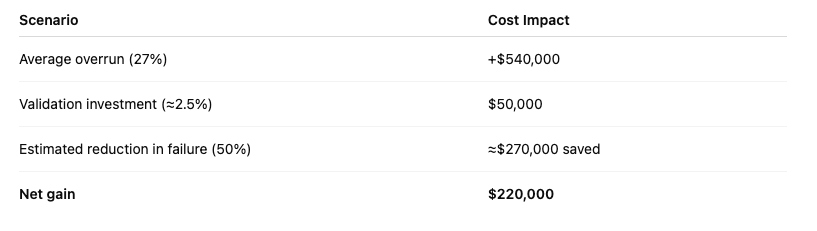
This isn’t an isolated error; it’s systemic. According to Bent Flyvbjerg and Alexander Budzier (Oxford University and Harvard Business Review), a study of 1,471 IT projects showed an average cost overrun of 27%, and one in six projects exceeded 200%—a phenomenon they called the “black swan” effect. The Project Management Institute’s Pulse of the Profession 2023 report echoes the pattern: misalignment and weak governance remain top drivers of failure, leading to significant waste across global portfolios.
Every one of those failures began as a decision that wasn’t validated.
Validation Is the New Risk Management
Many leaders view validation as a hindrance, a delay in execution. In reality, it’s the only form of speed that compounds safely.
Validation isn’t bureaucracy. It’s discipline. It’s the practice of testing assumptions before they scale.
It means asking the questions that often feel uncomfortable:
- Is the data credible?
- Are the people accountable?
- Can the outcome withstand scrutiny?
AI can automate analysis, but it can’t authenticate truth. That still requires human judgment, structured, transparent, and accountable.
In this sense, validation is no longer a compliance function; it’s a cultural one. It’s how organizations translate integrity into repeatable behavior.
Technology Reveals Character
Every era has a test of integrity. For the industrial age, it was how leaders treated labor. For the financial age, how they managed capital. For the digital age, it’s how they govern information.
AI makes decisions immutable—recorded, replicable, and traceable. Once a flawed assumption enters the system, it scales instantly.
That’s where immutability meets immorality. Once an unvalidated output reaches the public domain, the question is no longer technical; it’s ethical.
The problem isn’t “AI risk.” It’s a leadership risk.
Technology simply reveals the moral fabric of the people deploying it. If shortcuts were common before automation, AI only multiplies their consequences.
Validation isn’t a process—it’s a reflection of character.
Christopher Donaleski Tweet
The ROI of Certainty
Validation has a quantifiable return.
Consider a $2 million transformation project:
When Technology Becomes a Truth Test
AI has created a new kind of audit trail. Every prompt, every output, and every approval is timestamped evidence of how decisions are made.
In the past, errors could be buried in meeting notes or overlooked due to personal discretion. Today, transparency is involuntary. The way you decide is as visible as what you decide.
That visibility can be uncomfortable, but it’s also liberating. It allows leaders to close the gap between intent and impact. It transforms governance from a reactive shield into a proactive advantage.
Executives who embrace this shift will lead not just in performance but in perception. Because when decisions are visible, trust becomes strategy.
A stupid man's report of what a clever man says is never accurate, because he unconsciously translates what he hears into something that he can understand"
~Bertrand Russell
The Decision Still Belongs to You
AI can assist, accelerate, and even propose your next idea. But the final choice—to trust it, to act on it, to release it—still belongs to you.
The real danger isn’t that AI will make the wrong decision. It’s that humans will stop validating the right ones.
Every boardroom now faces a simple, defining question: Will you validate what AI creates before it validates you?
The Leadership Imperative
Deloitte’s refund will soon disappear from headlines, but its lesson should echo for years.
The winners of the AI era won’t be the fastest adopters—they’ll be the most accountable ones. They’ll design systems where validation is expected, not exceptional. They’ll treat transparency as an asset, not a risk.
Because when everyone has access to the same technology, character becomes the ultimate differentiator.
In the end, validation isn’t about data accuracy. It’s about moral accuracy.
The future won’t remember who used AI first. It will remember who used it wisely.
Citations
- “Deloitte Issues Refund for AI-Assisted Report Errors.” Business Insider, October 2025.
- Bent Flyvbjerg & Alexander Budzier, “Why Your IT Project May Be Riskier Than You Think.” Harvard Business Review, September 2011.
- Pulse of the Profession 2023: Powering the Future of Project Work. Project Management Institute (2023).
Author Note
Some portions of this article may include AI-generated text or insights derived through AI-assisted research. Information was gathered from a variety of reputable sources, including news outlets, media organizations, and publicly available reports.
The views and interpretations expressed here are solely those of Christopher Donaleski and do not necessarily represent the positions of any organizations or partners referenced. While every effort has been made to ensure accuracy, any factual errors or misinterpretations will be promptly corrected upon identification.


Can’t wait to see the positive impact this will have on operational workflows and client experiences!
Comments are closed.