
The operator-to-owner transformation isn’t a leadership philosophy. It’s a structural valuation event — and the firms that measure it are the ones capturing a premium at exit.
Every M&A broker has seen it: the business that looks like a premium asset on paper but collapses into a distressed deal the moment the owner steps back from the table. The culprit is almost never the financials. It’s the decision architecture.
There is a question that every quality-of-earnings analyst implicitly asks but almost no advisor formally measures: Does this business know how to decide without its founder? If the answer is no — and in the majority of owner-operated businesses below $50M in revenue, the answer is no — the enterprise is not truly transferable. It is, at best, a well-compensated job with a covenant attached.
This distinction sits at the heart of what AI Advisory Group calls decision sovereignty. A decision-sovereign enterprise is one in which the organization’s most consequential choices — allocation, hiring, pricing, market entry, risk tolerance — are governed by validated frameworks rather than by the intuition, relationships, and tacit knowledge locked inside a single operator. It is not merely a leadership development concept. It is a structural precondition for value creation at exit.
The Operator's Discount: What Buyers Actually Price
When a strategic buyer or PE sponsor underwrites a deal, they are not purchasing past performance. They are purchasing the probability of future performance in the absence of the seller. That probability is directly correlated with the degree to which decisions — strategic and operational — can be made confidently by people who are not the founder.
Owner-dependency manifests across the value spectrum in predictable ways. At the low end, it appears as key-person risk: one executive holds the primary customer relationships, and revenue concentration follows the individual. At the higher end, it is subtler and more damaging: the organization cannot generate, evaluate, or act on strategic options without escalating to the top. Decisions stall. Market timing is missed. Talent atrophies under a ceiling that only one person can break through.
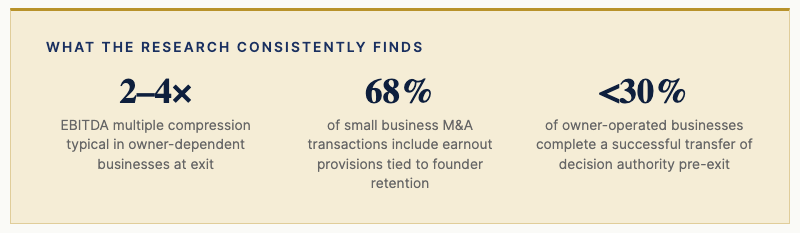
Sophisticated buyers discount for all of this. The earnout — that deferred payment structure that sellers routinely resent and buyers routinely require — is in most cases a direct proxy for unmeasured decision risk. It is the buyer’s hedge against the scenario in which the answers to every important question walked out the door on closing day.
Validation Architecture as an Exit Asset
The VALID Framework — developed by AI Advisory Group as the structural backbone of its Decision Intelligence practice — offers a different model. Rather than treating decision-making as a leadership style to be coached, VALID treats it as a system to be engineered. The five validators — Verity, Association, Lived Experience, Institutional, and Desire — map the cognitive and organizational inputs that govern how choices are made and legitimized within an enterprise.
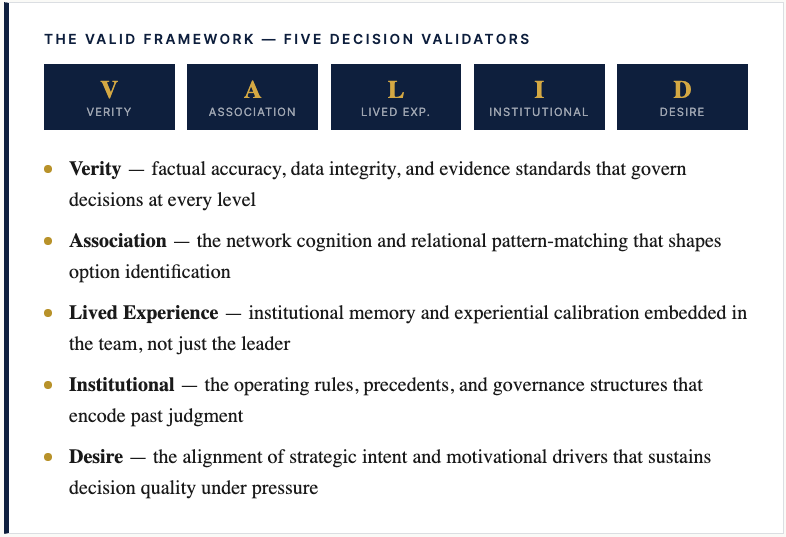
When these validators operate primarily inside the founder, the business has a high DBI — Decision Burden Index. When they are distributed across roles, processes, and systems, the business has low DBI and high decision portability. That portability is what buyers are actually acquiring when they pay a premium multiple.
“The question isn’t whether your business is profitable. The question is whether it can decide without you. If the answer is no, you’re not selling a company. You’re selling a job.”
— AI Advisory Group · Operator to Owner Transformation
The DI360™ and the Decision Validation Index
To move this from concept to diligence-grade evidence, AI Advisory Group developed the DI360™ — a 44-item behavioral assessment across seven decision domains — and its companion metric, the Decision Validation Index (DVI). Together, they produce a quantified snapshot of where a business sits on the owner-dependent to decision-sovereign continuum.
The DVI operates on a dual-axis model: it measures both the quality of decision processes (are the right validators active?) and the distribution of decision authority (is validation confined to the owner, or distributed across the leadership architecture?). A high-DVI business demonstrates that consequential choices are being made through consistent, documented, distributable processes — not through the founder’s intuition, relationships, and speed-of-trust.
For M&A advisors, this creates an entirely new category of pre-transaction deliverable. Rather than relying on anecdotal assessments of “management depth,” advisors can present a scored, domain-specific profile of decision portability. For clients in the $5M–$50M range preparing for a three-to-five-year exit, the DVI becomes a roadmap: here is where your decision architecture is transferable, and here is where it is not.
The 4A Pathway: Engineering the Transition
Knowing that a business has a low DVI is the beginning, not the end. The 4A Validation Pathway — Assess, Apply/Delete, Accelerate, Automate — provides the structured transformation sequence through which owner-dependent organizations build decision infrastructure.
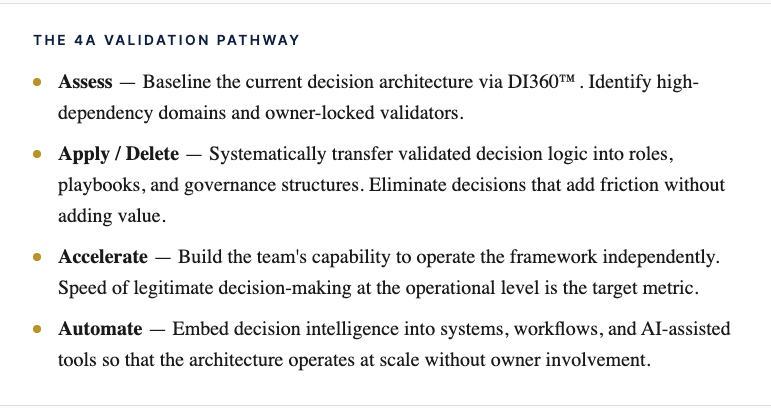
For a business 24–36 months from a targeted exit, executing the 4A pathway is the highest-ROI activity available to the owner — not because it improves operations in the short term (though it does), but because it systematically eliminates the primary source of valuation compression at the transaction table.
A New Conversation for M&A Advisors
The practical implication for M&A brokers, business brokers, and M&A attorneys is straightforward: the clients who engage in validation architecture work before coming to market will transact faster, compress their earnout exposure, and command premium multiples in the same industry cohort. The clients who do not will face the familiar friction — extended LOI periods, retrade attempts, earnout structures, and the valuation gap that no financial presentation can close once a sophisticated buyer has assessed the decision dependency risk firsthand.
AI Advisory Group’s Owner Readiness Assessment and 90-Day Business Readiness Intensive are designed specifically to address this gap in the pre-transaction window. They are not management consulting engagements. They are enterprise value construction projects — and the most compelling referral case for any advisor whose clients are measuring their business by what it will be worth when it’s time to exit.