Built to Exit: Why You're Closer Than You Think, and What's Quietly Holding You Back
Strategic Planning Begins With Knowing Where You Actually Are
Most business owners do not wake up one day and decide they want to build a company that traps them.
In the beginning, the business represents freedom. Independence. Opportunity. The ability to control your future and create something meaningful. For many owners, the early years are fueled by hustle, instinct, sacrifice, and problem-solving. The company grows because the owner grows.
Then something changes.
The business gets larger, but life does not necessarily get easier. Revenue increases, but so does complexity. More employees are added. More customers arrive. More software gets layered in. More responsibilities pile up. Eventually, many owners reach a point where they quietly start asking themselves questions they never expected to ask. Why does growth feel heavier instead of easier? Why does every important issue still come through me? Why can’t I fully step away from the business? Why do systems keep breaking under pressure? Why does scaling feel chaotic? Could I actually sell this company if I wanted to? Where do I even begin?
That last question is the one most business owners are really asking. Not how do I sell my business?, but how do I figure out where I actually stand? And that is where strategic planning should begin.

The Uber Ride That Explains Almost Every Business Problem
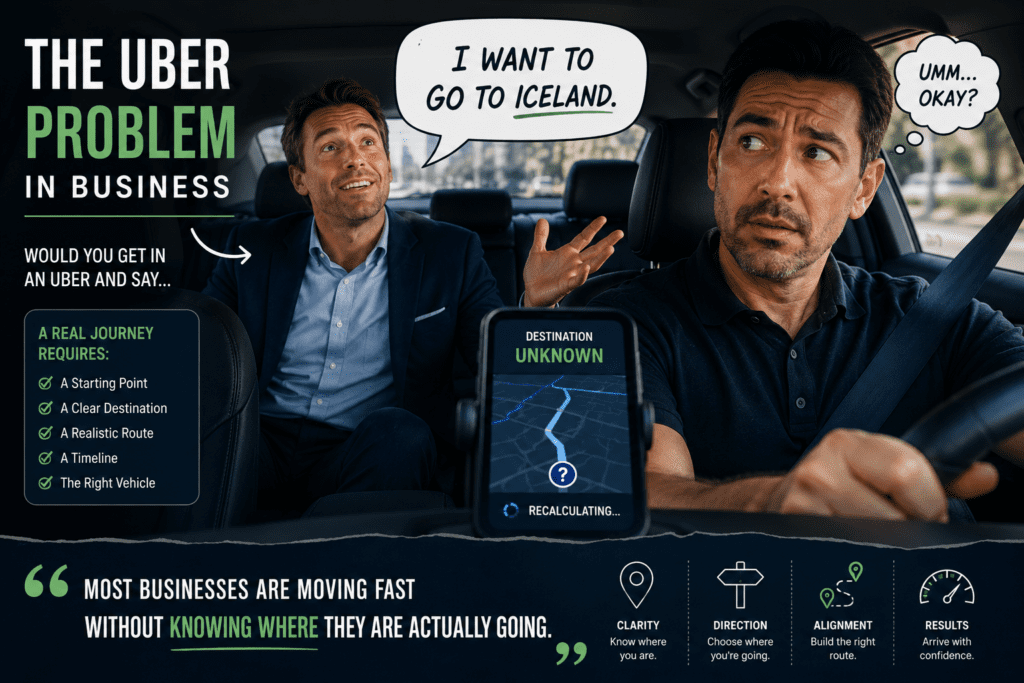
One of the simplest ways to explain strategic planning is through something almost everyone uses today: Uber. Every time you open the app, the first thing it asks is, “Where are you going?” Simple. But imagine getting into the car and telling the driver, “Take me to Iceland.” The driver would stare at you like you lost your mind — not because Iceland is impossible, but because you skipped every detail required to make the trip happen. You didn’t provide a realistic route, a timeline, a starting point, a transportation plan, or even whether the destination could be reached by car.
Yet this is exactly how many businesses operate. Owners say they want to scale, to grow, to prepare for AI, to sell the business, to have more freedom. But those are not destinations — they are categories. Strategic planning begins when vague aspirations become measurable direction.
This is one of the biggest problems inside small and mid-sized businesses today. Owners know they want something different, but they do not fully understand where they currently stand, what is actually holding them back, what creates risk, or what needs to happen first. As a result, businesses drift into reactive decision-making instead of intentional growth.
Most Businesses Were Built to Operate — Not Built to Transfer
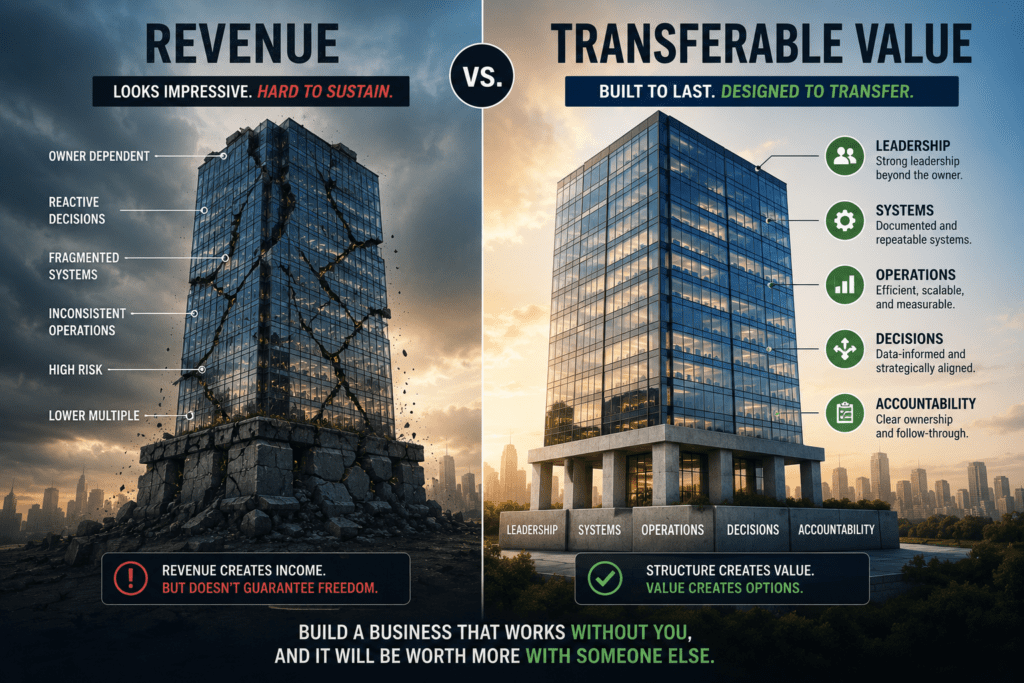
A business can generate millions in revenue and still have very little transferable value. That surprises many owners. The reality is that many businesses were unintentionally built around the owner’s relationships, the owner’s decision-making, the owner’s memory, the owner’s energy, and the owner’s constant involvement.
At first, this works. In the early stages of a company, founders often need to wear every hat. They solve problems quickly, move fast, close deals, and hold operations together through sheer effort. But many businesses never evolve beyond that stage. The company grows larger, but the operational structure underneath it never matures at the same pace. This creates invisible risk.
From the outside, the business may appear healthy. Revenue is growing. New clients are coming in. The team is expanding. Internally, however, the business becomes fragile because too much still depends on one person. The owner becomes the bottleneck, the approver, the firefighter, the relationship manager, the institutional memory, and often the emotional stabilizer for the organization. This creates a dangerous situation where the company can continue generating income while simultaneously becoming harder to scale and significantly harder to sell.
The data on this is sobering. Industry M&A research and exit planning studies consistently show that roughly 80% of businesses listed for sale never successfully sell, and one of the biggest reasons is excessive owner dependency. Businesses that rely heavily on founder involvement are viewed as higher-risk acquisitions. That means many owners spend decades building businesses that may not ultimately create the outcome they expected.
Why Growth Starts Feeling Heavy
Most businesses think they have a growth problem. In reality, growth is often exposing deeper operational weaknesses that already existed. Growth magnifies complexity.
As companies expand, communication becomes harder, accountability becomes less clear, decisions slow down, technology becomes fragmented, operational gaps widen, margins tighten, and teams become disconnected. This is why many companies hit invisible ceilings during expansion. The issue is not lack of opportunity — the issue is lack of operational maturity. The business grows faster than the infrastructure supporting it. At first, hustle compensates for these weaknesses. Eventually, complexity overwhelms hustle.
This is one of the reasons strategic planning must go beyond revenue targets. Businesses cannot simply ask, how do we grow? They must also ask what breaks under growth, what creates operational friction, what happens if the owner steps away, how decisions are being made, where communication fails, and what dependencies create risk. Those questions are what separate scalable businesses from chaotic businesses.
Research across organizational development and digital transformation makes this even clearer. Approximately 70% of transformation initiatives fail, and misalignment between leadership, operations, and execution is one of the leading causes. Companies often invest in technology before validating operational readiness — but technology cannot solve unclear direction. In many cases, it accelerates existing problems.
The AI Problem Most Companies Are Missing
Right now, businesses everywhere are racing toward AI because they are afraid of being left behind. But AI does not automatically improve decision-making — AI amplifies existing decision-making. That means healthy businesses accelerate while unhealthy businesses scale confusion. Aligned organizations gain leverage while reactive organizations create more chaos.
This is why AI should not simply be viewed as a software conversation. It is a strategic readiness conversation. Businesses lacking operational clarity, leadership alignment, process maturity, clean data, accountability structures, and consistent decision-making will struggle to maximize AI investments. In fact, many organizations are currently automating instability.
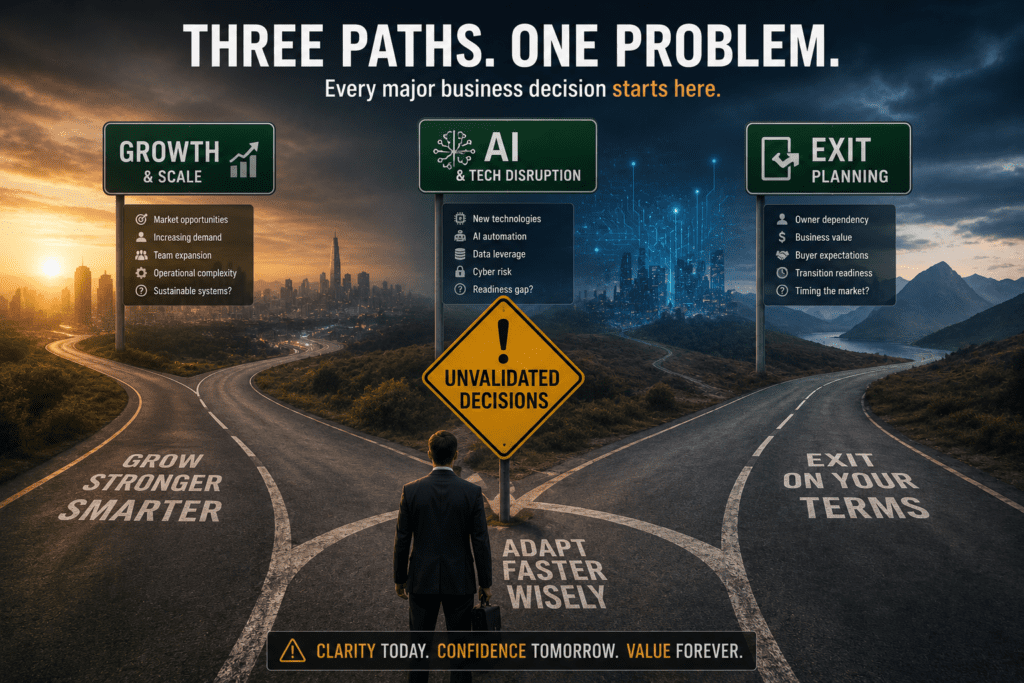
AI Advisory Group frames this challenge around three major business decision categories: Growth & Scale, Tech Disruption & AI, and Exit Planning. The important realization is that these are not separate problems. They are connected through decision quality.
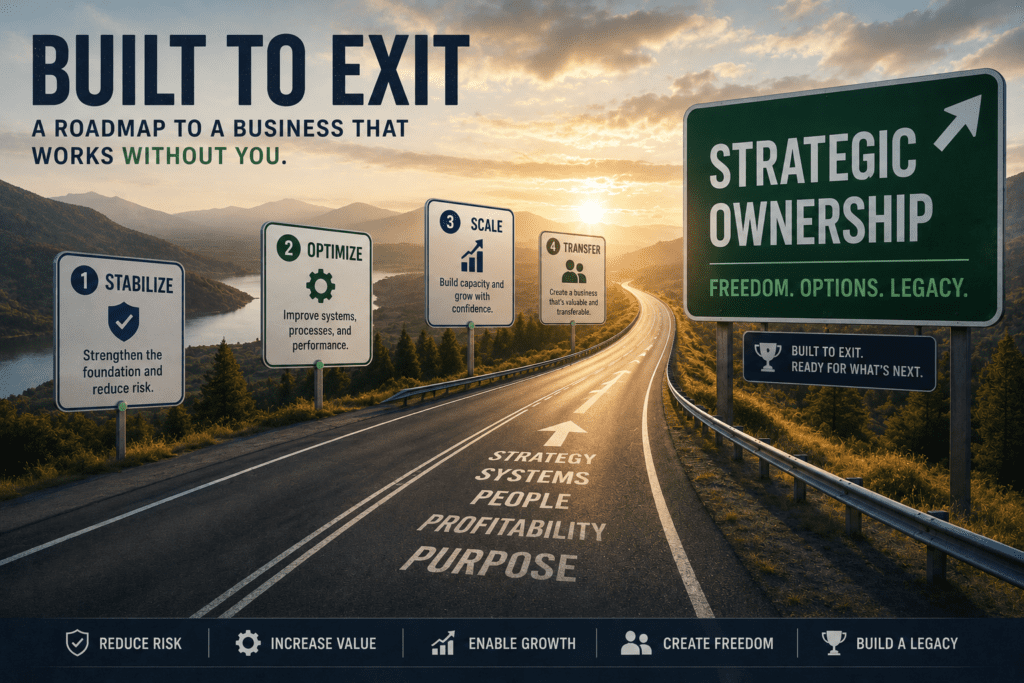
Exit Planning Is Not About Leaving — It Is About Creating Options
One of the biggest misconceptions in business is that exit planning starts when someone is ready to retire. In reality, the best exit planning often begins years earlier, because the real goal is not simply selling a business. The real goal is creating options.
A healthy business should create the ability to scale confidently, reduce owner dependency, delegate effectively, attract investors or buyers, transition leadership smoothly, improve valuation, increase freedom, and operate consistently without constant founder involvement. Ironically, businesses prepared for exit are often the healthiest businesses overall. Why? Because they are forced to improve systems, leadership, communication, operational maturity, accountability, financial visibility, repeatability, and strategic alignment. These are not just “exit planning” activities — they are healthy business activities. The businesses that create long-term enterprise value are usually the businesses that stop relying on founder heroics and start building operational architecture.
Buyers understand this intuitively. Private equity groups, strategic buyers, and investors typically pay higher multiples for businesses that demonstrate recurring and predictable revenue, operational consistency, reduced founder dependency, scalable systems, leadership depth, documented processes, financial visibility, and lower operational risk. The lower the dependency risk, the stronger the valuation potential.
Why Assessment Must Come First
One of the biggest mistakes businesses make is jumping directly into solutions before understanding the true condition of the business. That creates wasted investment, poor alignment, and frustration. This is why AI Advisory Group always starts with assessment first. No shortcuts. No assumptions. No generic recommendations.
Before building a roadmap, businesses first need clarity around where operational friction exists, where risk lives, what creates dependency, how decisions are being made, where value leaks, and what breaks under pressure. The goal of strategic planning should not be creating more complexity — it should be simplifying complexity.
Most owners do not need another motivational speech. They need visibility. They need someone to help them identify where they currently stand, understand what is holding them back, prioritize what matters most, and create a realistic path forward. Because uncertainty — not lack of effort — is often what keeps businesses stuck.
The Businesses That Thrive Over the Next Decade Will Be Different
The next decade will not simply reward the biggest businesses, the fastest-growing companies, or the organizations with the most AI tools. It will reward companies with operational clarity, validated decision-making, strategic adaptability, leadership alignment, scalable systems, reduced dependency, and the ability to move intentionally under pressure.
Businesses do not grow at the speed of effort. They grow at the speed of decisions. And the organizations creating long-term value over the next decade will not necessarily be the ones making the fastest decisions. They will be the ones making the clearest ones.